Artists have begun implementing nanotechnology in their artwork. This is interesting because you cannot really see things at the nanoscale in the same way that you see other things. Because of this, artists probably have more room for creativity and imagination. I think the use of nanotechnology is a bit romanticized in today's culture and is seen as very high-tech and powerful; this is probably because of the lack of contact of society with the actual science and the difficulty of visualization, as stated by Gimzewski.
 |
| Quantum corrals http://researcher.watson.ibm.com/researcher/ view_group_subpage.php?id=4252 |
I am currently taking a course on quantum chemistry, so I have been learning about the properties of things at the quantum mechanical level, which are very different from properties at the classical mechanical level. It is definitely very abstract and difficult to visualize, but it is really cool that we are able to come up with models that are good enough approximations to practically apply. One of our past exam questions involved nanoscale structures. More specifically, we applied the particle-in-a-box model to a square-shaped quantum corral.
 |
| DNA origami; short strands connect different parts of longer strand, causing folds http://openwetware.org/wiki/Biomod/2014/Design |
The different properties at the quantum level in nanostructures has caused the development of new, smaller technologies. People are applying concepts used on the normal, classical scale to the nanoscale, like programming and origami. Kurzweil observed that the growth of informational technology has been consistently exponential for many years, which means it will continue becoming smaller in size and more powerful. He believes that eventually, nanotechnology will become more integrated with people's bodies. However, the science of nanotechnology is still very new and we do not know much about its effect on the human body, so I think it is hard to say how much we will be using nanotechnology in the future.
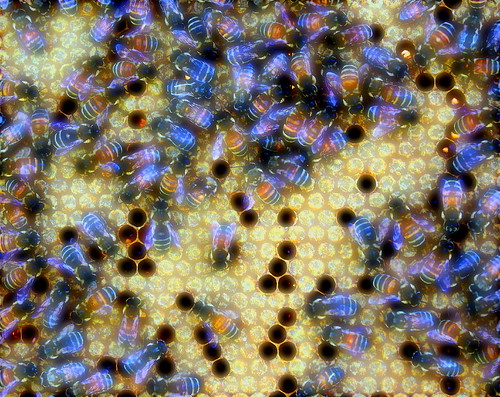 |
| Nanobees, designed to work in our bloodstreams, might become a reality in the future. http://blog.longnow.org/02009/10/14/invasion-of-the-nanobees/ |
Sources:
"Art in the Age of Nanotechnology." Art.Base. Art.Base, 11 Mar. 2010. Web. 19 May 2016.
Gimzewski, Jim, and Victoria Vesna. "The Nanomeme Syndrome: Blurring of Fact & Fiction in the Construction of a New Science." Victoria Vesna. Web. 19 May 2016.
"Making Stuff: Smaller." PBS. PBS, 21 Aug. 2013. Web. 19 May 2016.
"Paul Rothemund: DNA Folding, in Detail." TED. Feb. 2008. Web. 19 May 2016.

It is amazing how nanotechnology is being used for art and science and how they can even self-assemble and self-organize sometimes. Do you think that as nanotechnology becomes more complex that humans will eventually have to assemble and organize nanoparticles on their own because of size?
ReplyDelete